Dry eye

Moderate meibomian gland dysfunction (MGD)

Saint-Étienne, France

dr trone 6499a6dd761f6206850004 1

Dr Marie-Caroline Trone

Hospital-based Ophthalmologist Saint-Étienne University Hospital – France

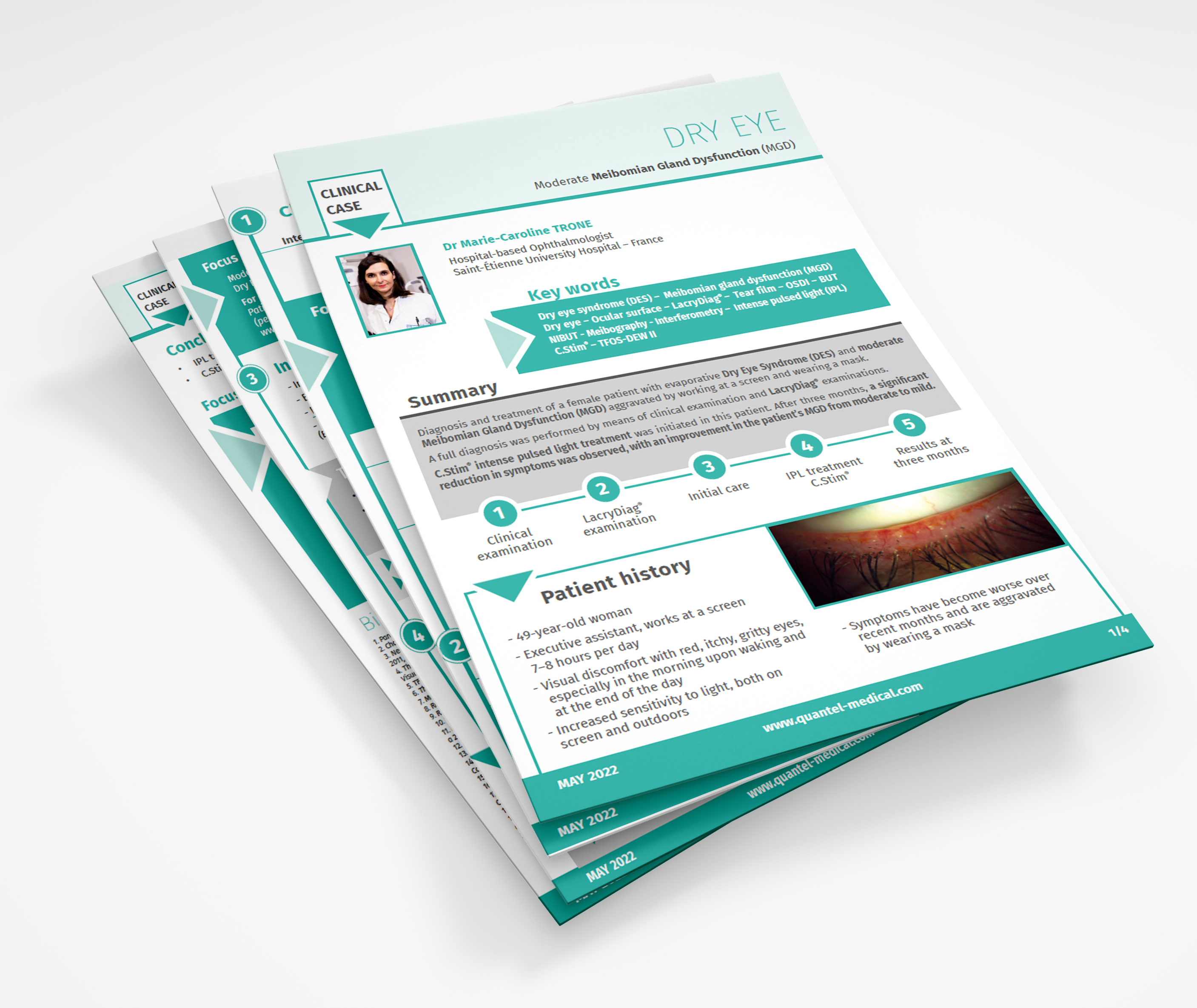
This is a diagnosis and a treatment of a female patient with evaporative dry eye syndrome (DES) and moderate meibomian gland dysfunction (MGD) aggravated by screen work and wearing a mask. A full diagnosis was performed by means of clinical examination and LacryDiag® examinations. Intense pulsed light (IPL) treatment with C.Stim® was initiated in this patient. After three months, a significant reduction in symptoms was observed, with an improvement in the patient's MGD from moderate to mild.

Anamnesis :

Ms L., aged 49, an executive assistant, consulted complaining of visual discomfort, involving redness, itching and a gritty sensation in the eyes. These symptoms were most obvious in the morning upon waking and at the end of the day. She was experiencing considerable sensitivity to light when using a screen and outside. She said the symptoms had been more noticeable over the past few months and were made worse by wearing a mask. Her work requires her to spend a long time working on a screen: around seven or eight hours per day.

#1

Clinical examination

clinical exam 1 63b406f4d0eed888129604 1

The interview did not reveal any relevant medical history or ongoing treatments. When questioned on risk factors for dry eye, the patient was found to be an active smoker, consuming around 10 cigarettes per day. 

The results of the eye examination were as follows:

The OSDI questionnaire was used, giving a score of 43.75.

The use of questionnaires such as the OSDI, DEQ-5 and SPEED is a useful addition to the interview and enables a rapid assessment of the severity and variety of symptoms experienced. They can be used to monitor dry eye syndrome progression and the effects of any treatments given. These tests are easy to use and can be filled in by patients in the waiting room.

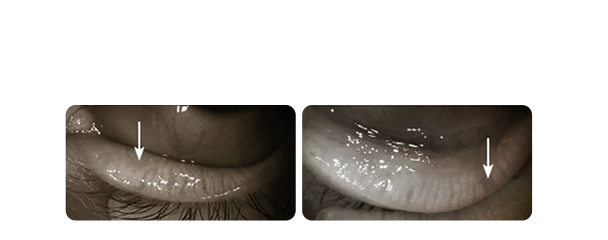
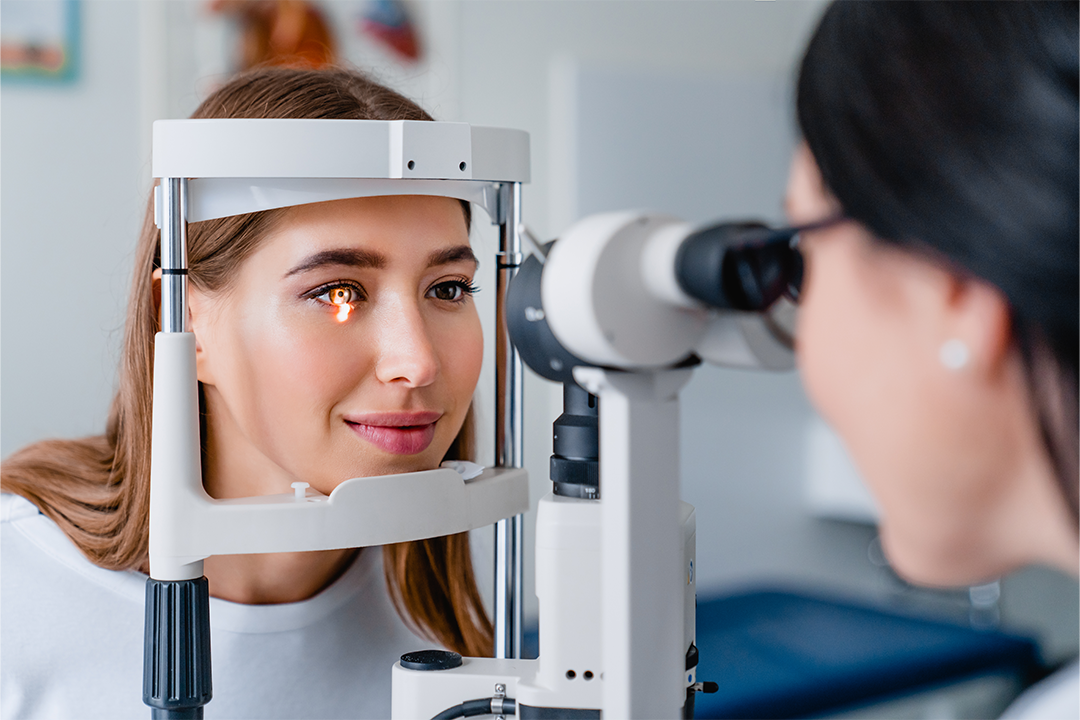
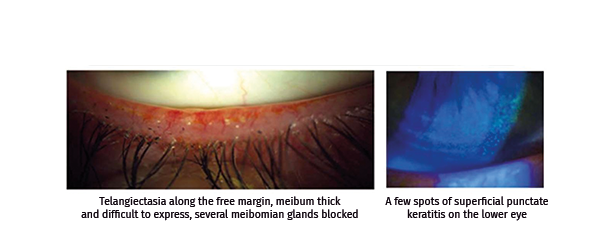
The clinical examination concluded with a slit lamp examination that revealed moderate meibomian gland dysfunction (MGD) with incomplete blinking. The right eye had a break-up time (BUT) of 5 seconds and the left eye of 4 seconds, with significant tear instability.

#2

Ocular surface analysis by LacryDiag®

ocular exam lacrydiag 1 63b4082784078597615417 1

The LacryDiag® ocular surface analyser performs four non-contact examinations based on the criteria detailed in the TFOS-DEWS 2 report:

  • Interferometry showed disruption of the lipid layer
  • Tear meniscus height was normal
  • NIBUT had dropped to 5.6 seconds, indicating tear instability
  • Meibography showed that some meibomian glands were dilated and blocked. A few glands were also atrophied.

The patient was diagnosed with moderate meibomian gland dysfunction (MGD) causing evaporative dry eye syndrome (DES). 

To improve treatment compliance, the patient was informed of her condition and given an explanation of its physiopathology by means of a personalised information sheet. The patient was also directed to My dry eye disease website to provide her with more detailed information on dry eye.

#3

Initial treatment

Preservative-free artificial tears were prescribed to the patient for instillation several times a day.
She was also advised to perform daily eye care, consisting of heating, massage and cleansing the eyelids. Blinking exercises were also explained to the patient.
Finally, the patient was encouraged to stop smoking, because smoke has a harmful effect on the ocular surface.

A two-month check-up appointment was scheduled. The patient was still experiencing discomfort. Her symptoms had reduced but were still present, despite good treatment compliance. Moderate meibomian gland dysfunction (MGD) was still present at the physical examination.

In light of this observation, C.STIM® IPL treatment was scheduled, with the continuation of the symptomatic treatment.

#4

C.STIM® IPL treatment protocol

ipl cstim 1 63b40a6729dec967740350 1

The treatment protocol comprised three sessions on Day 0, Day 15 and Day 45.

Four shots were performed per side per session at a fluence of 8 to 14 J/cm2. During the treatment, protective goggles were worn by everyone.

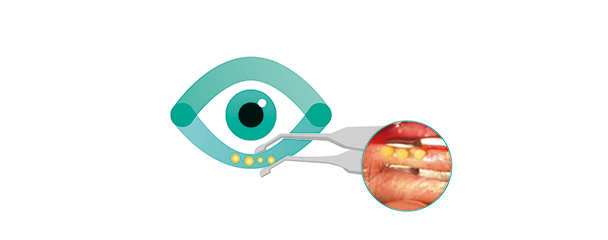
At the end of each session, meibum expression was performed using forceps, for optimal results. The heat generated by C.STIM© IPL treatment makes it easier to express the meibum by hand.

#5

Results at three months

Three months after the end of treatment, the patient reported a clear improvement in her symptoms, which was also evidenced by the OSDI test (OSDI of 43.75 on Day 0 vs. OSDI of 25 three months after). An improvement in meibomian gland dysfunction (MGD) from moderate to mild was also visible at the physical examination.

However, symptomatic treatment will need to be continued over the long term, and retreatment with IPL will be scheduled if necessary.

To conclude, IPL treatment with C.Stim® is fast, effective and safe.
C.Stim® IPL can be offered to patients with MGD when symptomatic treatment is insufficiently effective.


Get this case study 
in PDF format: click here