Dry eye

Meibomian gland dysfunction (MGD) aggravated by blepharoplasty

Bordeaux - France

dr marty

Dr Anne-Sophie Marty

Dr Anne-Sophie Marty, Thiers Ophthalmology Practice, Thiers Ophthalmology Clinic, Bordeaux, France

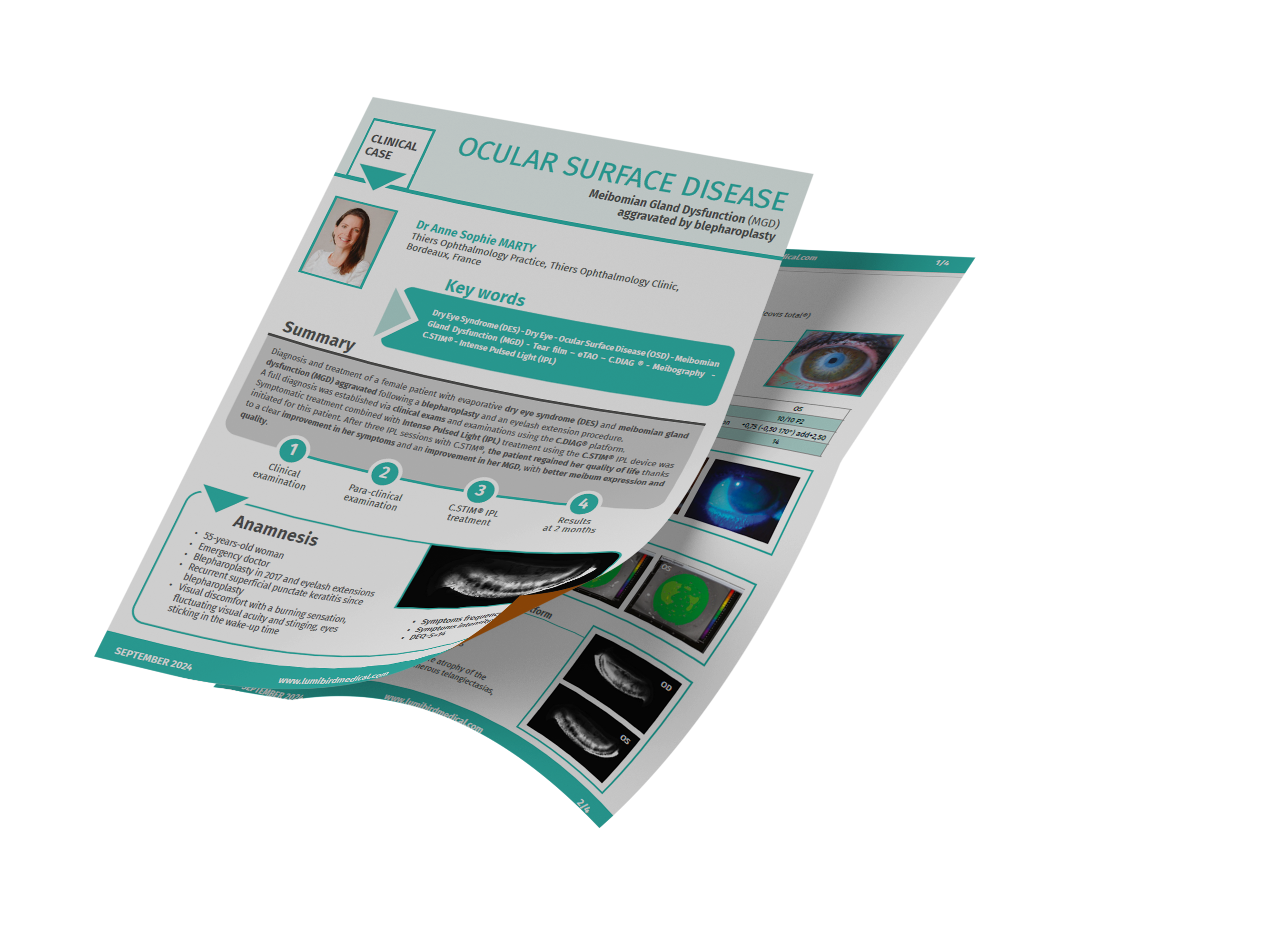
Diagnosis and treatment of a female patient with evaporative dry eye syndrome (DES) and meibomian gland dysfunction (MGD) aggravated following a blepharoplasty and an eyelash extension procedure. A full diagnosis was established via clinical examination and examinations using the C.DIAG® platform. Symptomatic treatment combined with intense pulsed light treatment using the C.STIM® IPL device was initiated for this patient. After three IPL sessions with C.STIM®, the patient regained her quality of life thanks to a clear improvement in her symptoms and an improvement in her MGD, with better meibum expression and quality.

Anamnesis :

Ms M.S., a 55-year-old female patient and emergency doctor, underwent a blepharoplasty in 2017, along with an eyelash extension. Since her blepharoplasty surgery, the patient has repeatedly suffered from superficial punctate keratitis. She experiences visual discomfort with a burning sensation, fluctuating visual acuity and stinging. She also wakes up with her eyes stuck together in the morning. She rates the frequency of these symptoms at 7/10 and their intensity at 7/10 as well. We perform the DEQ-5 test and she receives a score of 14.
#1

Clinical examination

clinical examination 2

The patient is currently using artificial tears on demand (Répadrop, Néovis Total).

The identified risk factors for dry eye syndrome (DES) are menopause, screen use, mask use, make-up use and a history of chalazion.

The eye examination yields the following results:

OD


OS

10/10 P2VA10/10 P2
+0.00 (-0.50 180°) add +2.50Refraction+0.75 (-0.50 170°) add+2.50
12IOP14


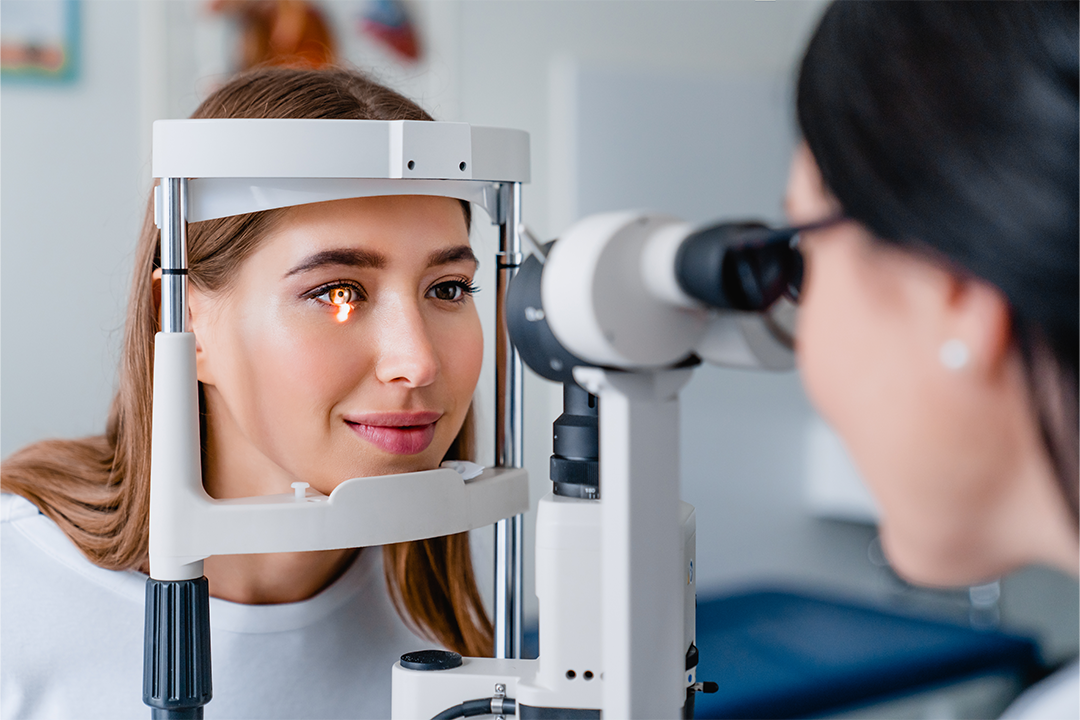
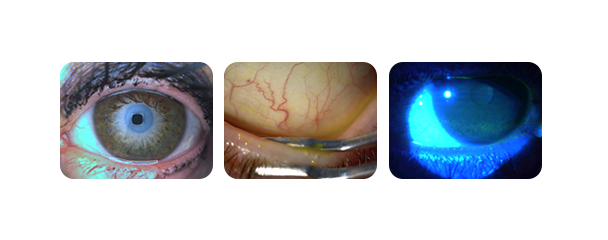
The slit lamp examination reveals inferior superficial punctate keratitis (SPK) OD>OS. The eyelid margin is scalloped and lashes are rubbing against the right lower eyelid. The meibum is thick with blocked glands, relieved using forceps.

#2

Para-clinical examination

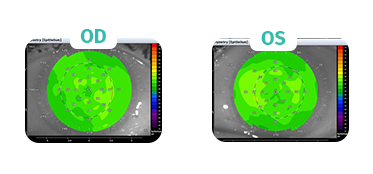
The para-clinical examination begins with epithelial mapping, which reveals the onset of epithelial atrophy in the upper and lower areas of the cornea.  

The ocular surface is then analysed using the C.DIAG® platform, yielding the following results:

  • Tear meniscus height: normal
  • Interferometry: OD and OS disrupted -> Disruption of the lipid layer
  • NIBUT: decreased to 4.6 sec OD // 6.2 sec OS -> Severe tear instability
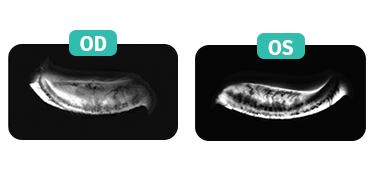
  • Transillumination meibography: severe atrophy of the meibomian glands, presence of numerous telangiectasias, blocked glands
#3

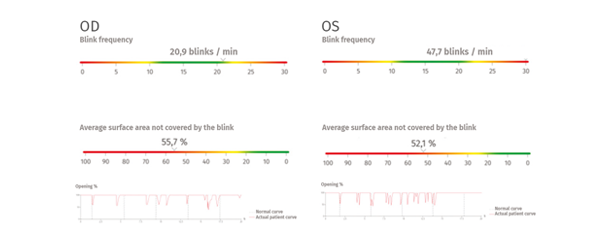
C.DIAG® blinking analysis

The results obtained using C.DIAG® show abnormal blinking, with increased blinking frequency and incomplete blinking most of the time. 

Working at a screen is the main cause of incomplete blinking. In addition, the blepharoplasty affected the delicate dynamics of the eyelids.

The report generated by C.DIAG® can be used to help educate patients.

#4

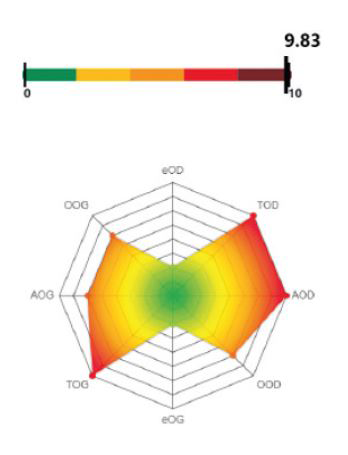
eTAO score

The eTAO score is a new DES severity score.

This score can be used in two ways: to screen patients before any refractive corneal/lens procedures, so that any latent dry eye is not missed, or to monitor patients with dry eye syndrome. It helps to guide treatments and can be used for patient education. 

The score includes severity levels for:

  • meibomian gland atrophy 
  • meibomian gland obstruction 
  • telangiectasia
  • epithelial atrophy

It is determined separately for each eye, taking into account the patient’s history, age, sex and the intensity and frequency of symptoms.

The eTAO score is a new DES severity score.

This score can be used in two ways: to screen patients before any refractive corneal/lens procedures, so that any latent dry eye is not missed, or to monitor patients with dry eye syndrome. It helps to guide treatments and can be used for patient education. 

The score includes severity levels for:

  • meibomian gland atrophy 
  • meibomian gland obstruction 
  • telangiectasia
  • epithelial atrophy

It is determined separately for each eye, taking into account the patient’s history, age, sex and the intensity and frequency of symptoms.

#5

Diagnosis

Severe meibomian gland dysfunction (MGD) is identified, causing evaporative dry eye syndrome (DES) aggravated by blepharoplasty.

An ophthalmological assessment should always be performed prior to blepharoplasty, to determine whether the patient has dry eye syndrome.

The proposed treatment is as follows:

  • eyelid care
  • blinking exercises
  • Théalose and Cationorm eye drops during the day
  • Liposic eye gel in the evening
  • Monthly treatment with Azyter eye drops
#6

C.STIM® IPL treatment

ipl treatment

The 2-month check-up showed that the patient is less bothered during the day. Her symptoms have reduced but are still present, despite good treatment compliance. SPK is persistent on clinical examination.

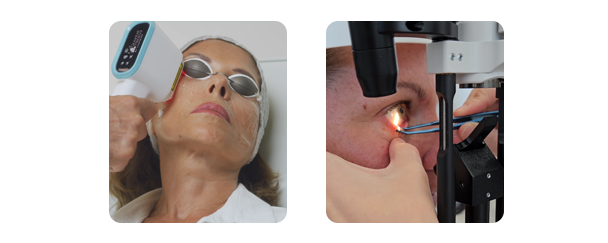
C.STIM® IPL treatment is initiated, in addition to continuing symptomatic treatment.

The treatment protocol comprises three sessions on D0, D15 and D30.

Four shots are performed per side per session at a fluence of 8 J/cm². Both the patient and the doctor wear protective goggles during the treatment.

At the end of each session, the doctor performs meibum expression using forceps, for optimal results. The heat generated by the C.STIM© IPL treatment makes it easier to express the meibum by hand.

#7

Results at two months

The patient can feel a clear improvement in her symptoms: less discomfort, to the point of forgetting her daily routines. She now feels no need to use artificial tears and no longer notices any discomfort from drafts. She explains that she is using a warming mask and massaging her eyelids several times a week. She practises blinking during her shifts and at home, and her eyes feel wetter after these exercises.

An improvement in her MGD can also be observed, since the flow is paler when using the forceps.

It is therefore important to continue the symptomatic treatment over the long term and to repeat the IPL treatment if necessary.

Conclusion:

C.STIM® IPL treatment is fast, effective and safe. It can be offered to patients with MGD when symptomatic treatment is insufficiently effective. It improves symptoms while reducing dependence on medication, enabling patients to improve their quality of life. 


Get this case study 
in PDF format: click here