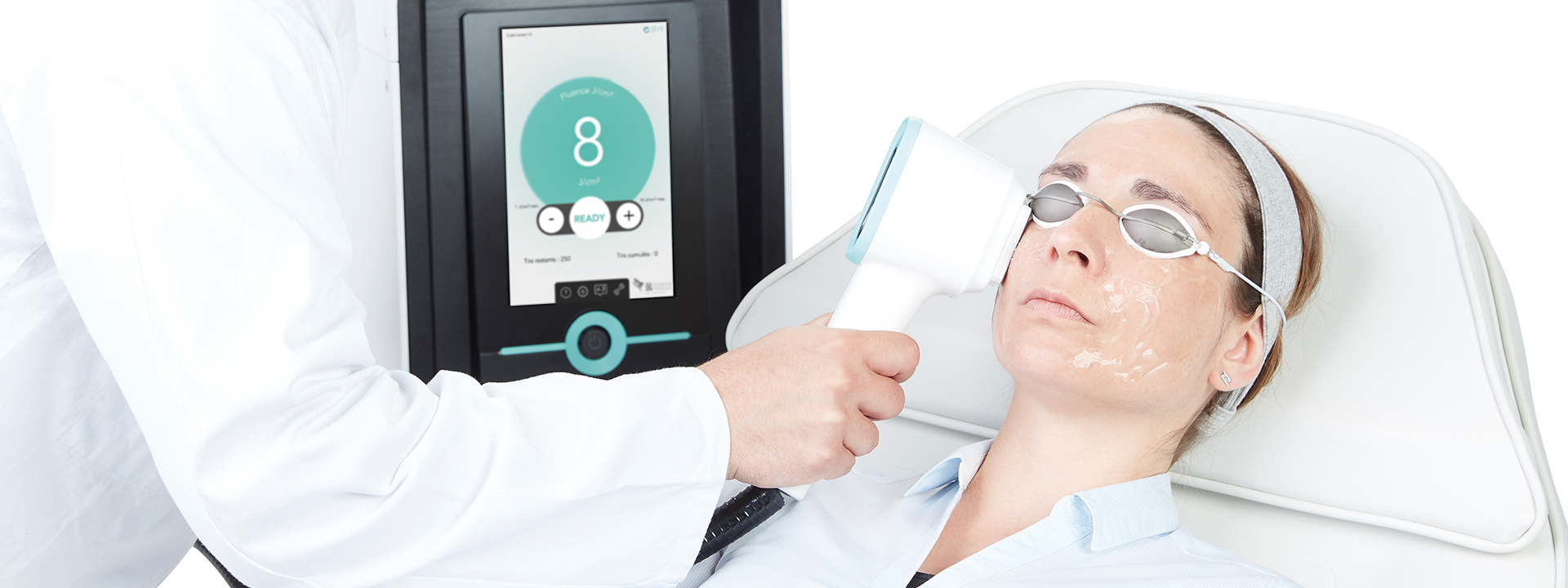
IPL technology has been used in dermatology since 1994 to treat of various pathologies, including skin rosacea, acne, vascular lesions and age-related pigmented lesions, as well as for skin rejuvenation and permanent hair removal.
IPL made its way into ophthalmology thanks to a US doctor, Dr Toyos, who discovered that during IPL treatments for skin rosacea, patients noticed a significant improvement in their dry eye symptoms.
The use of IPL then spread from dermatology to ophthalmology, particularly for the treatment of evaporative dry eye with meibomian gland dysfunction.
 Physical principles of IPL
IPL is based on the emission of high-intensity flashes using a xenon flash lamp. Unlike laser therapy, IPL uses non-coherent and polychromatic light, ranging from ultraviolet to infrared. This IPL light passes through a filter to remove ultraviolet rays and retain only the red and infrared light that has an effect on dry eye.
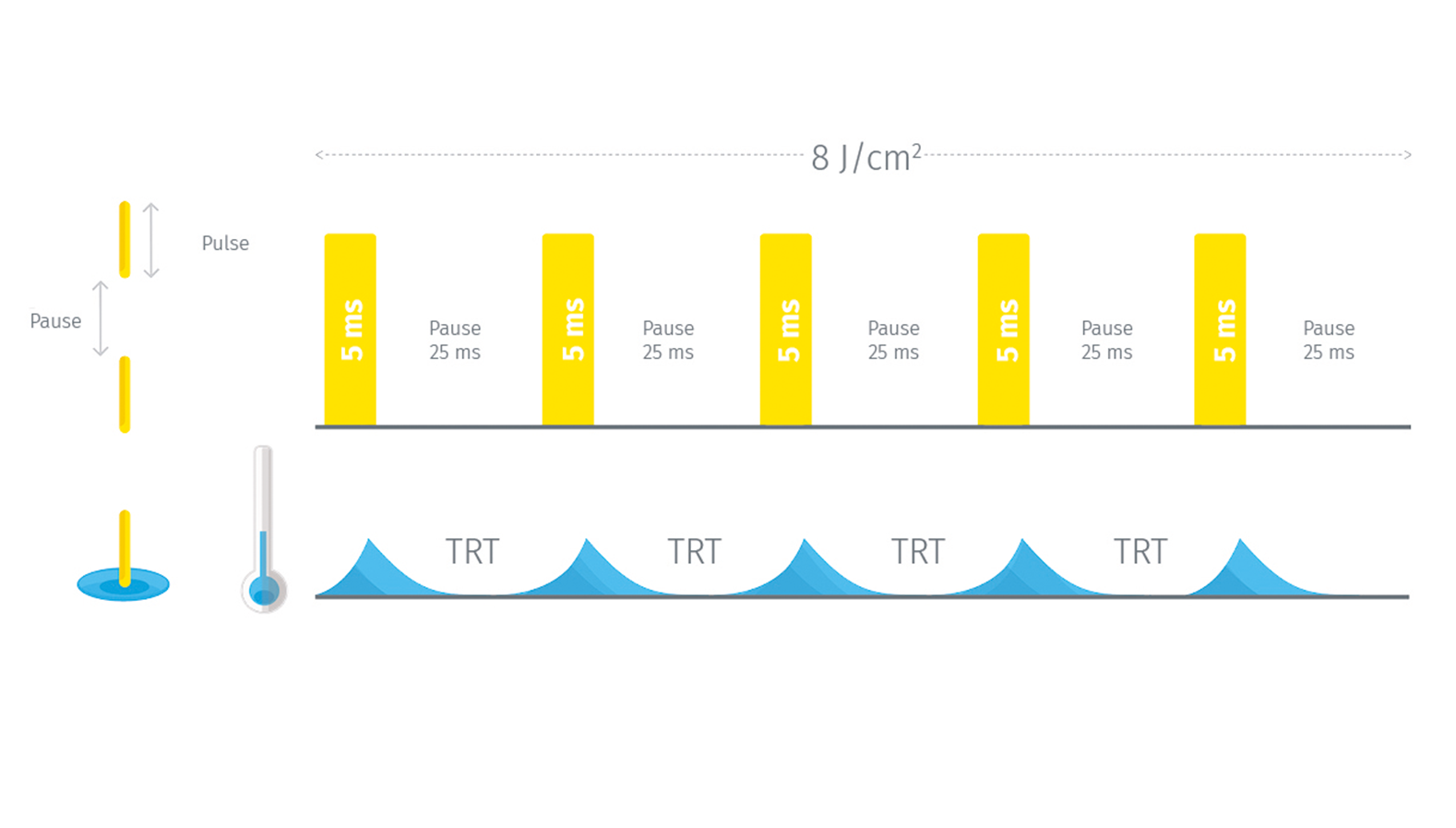
The emission spectra vary depending on the IPL device and the clinical indication, ranging from 400–610 nm to 1200 nm, with a fluence of between 8 and 56 J/cm2. The power levels used in ophthalmology are much lower than those used in dermatology where the aim is to destroy while in ophthalmology, the aim is rather to modulate.
The majority of IPL systems are based on very short calibrated pulses to limit skin heating and respect the skin’s relaxation time. The pauses are important, because they ensure that the skin and eyelids are stimulated rather than burned. Some IPL systems do not have regulated pulses train and can therefore burn the skin if the energy is not well dosed.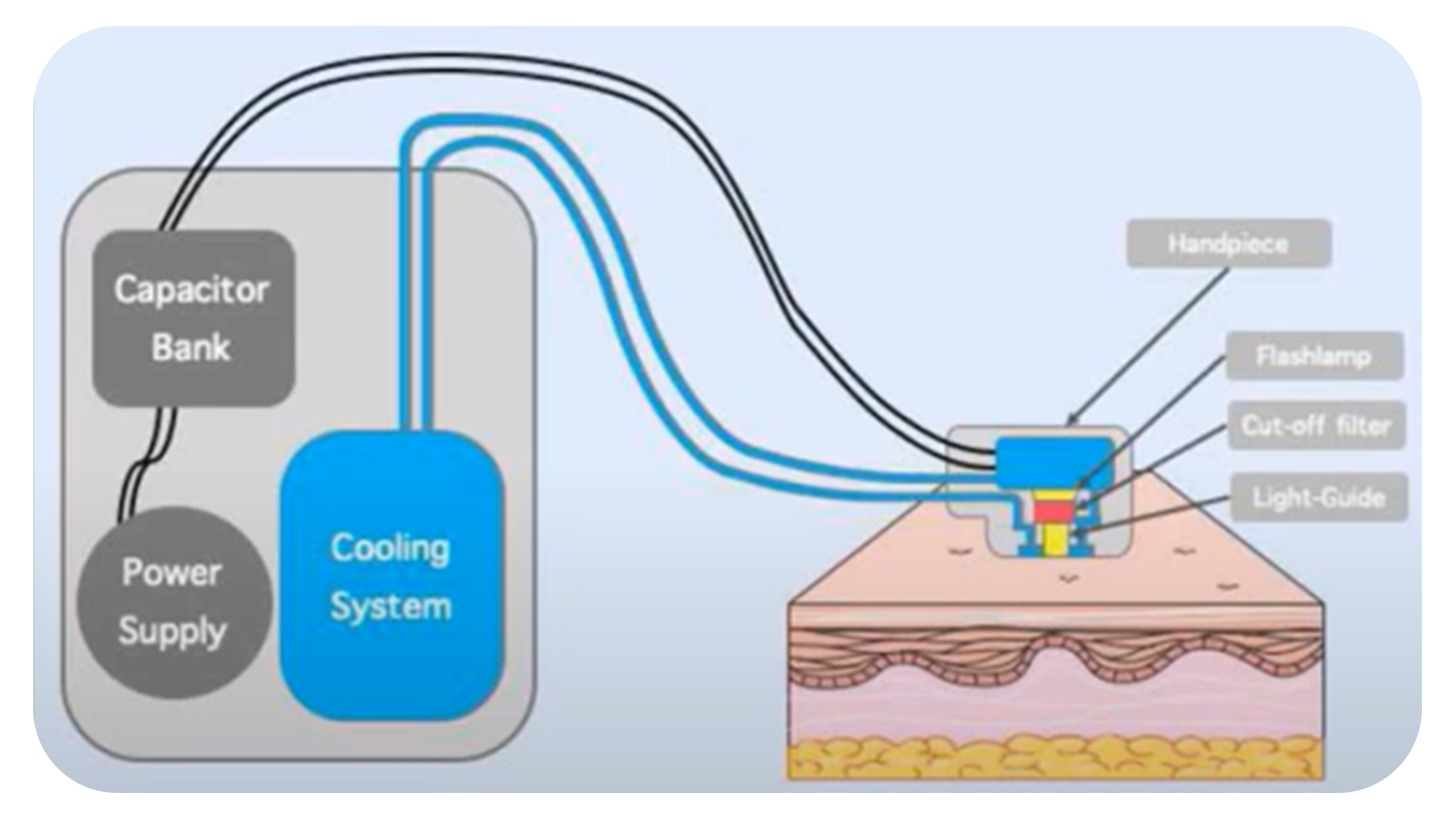
IPL devices consist of a handpiece with a flash lamp that emits the flashes, a filter and, in some cases, an optical diffusion system that ensures even delivery of light across the skin (STIM-ULI™, a technology patented by Quantel Medical and only available with C.STIM®).
IPL devices may also have a cooling system to ensure that the system is reliable, that the fluence delivered with each flash is consistent, and to optimise patient safety and comfort.
What are the mechanisms of action of IPL?
The main mechanism of action is accumulation of energy by molecules, the chromophores (such as melanin and haemoglobin); this energy then transforms into heat.
The mechanisms of action for the treatment of dry eye have yet to be fully elucidated and appear to be multiple. Below is a non-exhaustive list of the mechanisms of action of IPL that have been observed in clinical practice and demonstrated in clinical studies.
1. Vascular effects
Firstly, IPL acts on the blood vessels. In dermatology, flashing the blood vessels, and therefore the haemoglobin, creates vascular thrombosis as a result of the high levels of energy.
In ophthalmology, the palpebral telangiectasias being smaller at the level of the eyelids, the flash will rather have a localized heating effect at the level of the vessels and around the vessels. This modulates their function and changes their temperature, fluidifying the meibum found in the meibomian glands. Studies have shown that in cases of blepharitis, the number of telangiectasias in the eyelids decreased after IPL sessions.
Once this meibum has been fluidified, it is important to extract it by performing a meibomian gland expression, achieved by pressing the tarsus, thus increasing the effectiveness of IPL treatment.
Bibliographic reference: Bäumler W, Vural E, Landthaler M, Muzzi F, Shafirstein G. The effects of intense pulsed light (IPL) on blood vessels investigated by mathematical modeling. Lasers Surg Med. 007;39:132–139.
 2. Improving lipid layer and meibum quality
Some studies have shown other effects on the meibum after IPL sessions.
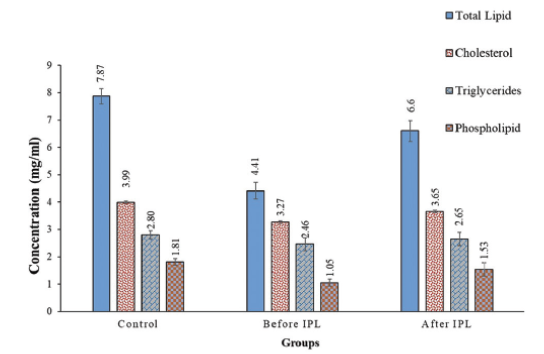
Indeed, a change in tear composition has been observed: two weeks after a single IPL session, the number of proteins and lipids in the tears increased. The tears are therefore enhanced, with an increase in cholesterol, triglycerides and, in particular, phospholipids, which are meibomian lipids important for the physiology of the tear film.
Bibliographic reference: Ahmed SA, Taher IME, Ghoneim DF, Safwat AEM. Effect of Intense Pulsed Light Therapy on Tear Proteins and Lipids in Meibomian Gland Dysfunction. J. Ophthalmic Vis Res. 2019;14(1):3–10
3. Improving meibomian gland dysfunction (MGD)
 IPL improves the structure of the meibomian glands. Some studies have found an improvement in the functioning of the meibomian glands due to a reduction in their obstruction. The glands are less dilated and there is an increase in the density of the acini, as shown in the figure below:
Bibliographic reference: Yin Y, Liu N, Gong L, Song N. Changes in the Meibomian Gland After Exposure to Intense Pulsed Light in Meibomian Gland Dysfunction (MGD) Patients. Curr Eye Res. 2018;43(3):308–1
4. Anti-inflammatory effect on the skin
Another effect of IPL is an anti-inflammatory effect on the skin, which is different from the anti-vascular effect. This effect has been demonstrated on skin cell cultures.
In tears, there is reduction in matrix metalloproteinase-9 (MMP-9), which is overexpressed in case of rosacea, as well as a reduction in numerous inflammatory cytokines. This anti-inflammatory effect of IPL is one of the most interesting and explains why IPL improves dry eye symptoms.
Bibliographic reference:
- Lee H, Han YE, Park SY, Lee JH, Chung HS, Moon SY, Kim JY, Tchah H. Changes in the expression of matrix metalloproteinase-9 after intense pulsed light therapy combined with meibomian gland expression in moderate and severe meibomian gland dysfunction. Cont Lens Anterior Eye. 2021 Jun;44(3):101339.
- Li Q, Liu J, Liu C, Piao J, Yang W, An N, Zhu J. Effects of intense pulsed light treatment on tear cytokines and clinical outcomes in meibomian gland dysfunction. PLoS One. 2021 Aug 26;16(8):e0256533
5. Photobiomodulation
 Another interesting effect could be photobiomodulation, although it is unclear whether this occurs with IPL. This effect is well demonstrated in publications with coherent laser light, or LEDs. Photobiomodulation refers to changes in cell function thanks to the light. This effect is of interest because the light modulates cell function by improving the mitochondrial mechanism. Mitochondrial respiration is therefore improved, resulting in fibroblast proliferation and collagen synthesis, and therefore tissue rejuvenation. IPL has been used for many years in dermatology to rejuvenate the skin, so why not at the eye level?
Bibliographic reference: H Chung. The nuts and bolts of low-level laser (light) therapy. Ann Biomed Eng. 2012;40(2):516–533.
6. Neuronal effect
When IPL is used to treat patients with neuropathic pain, these patients stop experiencing pain for several weeks. It therefore appears that there is an effect on sensory neurons and on parasympathetic and sympathetic innervation, and a stimulation of meibomian innervation. No in-vitro studies demonstrate this neuronal effect, but clinical results have been observed and are very interesting in terms of symptomatology.
7. Anti-Demodex/anti-infective effect
Studies have shown that using IPL reduces the number of Demodex.
One study shows the eradication of Demodex after three sessions in 83% of cases at M3. There is a progressive decrease in the number of Demodex on the eyelid over three months.
The best way to demonstrate the effect of IPL in terms of Demodex eradication is via a video.
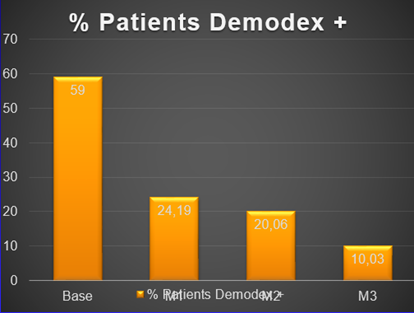
Bibliographic reference: Huo Y, Mo Y, Wu Y, Fang F, Jin X. Therapeutic effect of intense pulsed light with optimal pulse technology on meibomian gland dysfunction with and without ocular Demodex infestation. Ann Transl Med. 2021 Feb;9(3):2
In conclusion, IPL has multiple mechanisms of action and these have yet to be fully explained. All of these mechanisms most likely have a synergistic and complementary effect in the treatment of dry eye.
The results observed in routine clinical practice demonstrate that IPL is a beneficial treatment option for dry eye.
--
Source: Presentation by Dr Serge Doan (Bichat Hospital, Fondation Rothschild, Paris, France) during the Quantel Medical symposium at the SFO 2022 congress.
Replay: https://www.youtube.com/watch?v=Er-t8CdWbP8&list=PLAdA24jY-iBMpYBVqY9N7ARqWqyMPo8UG&index=3