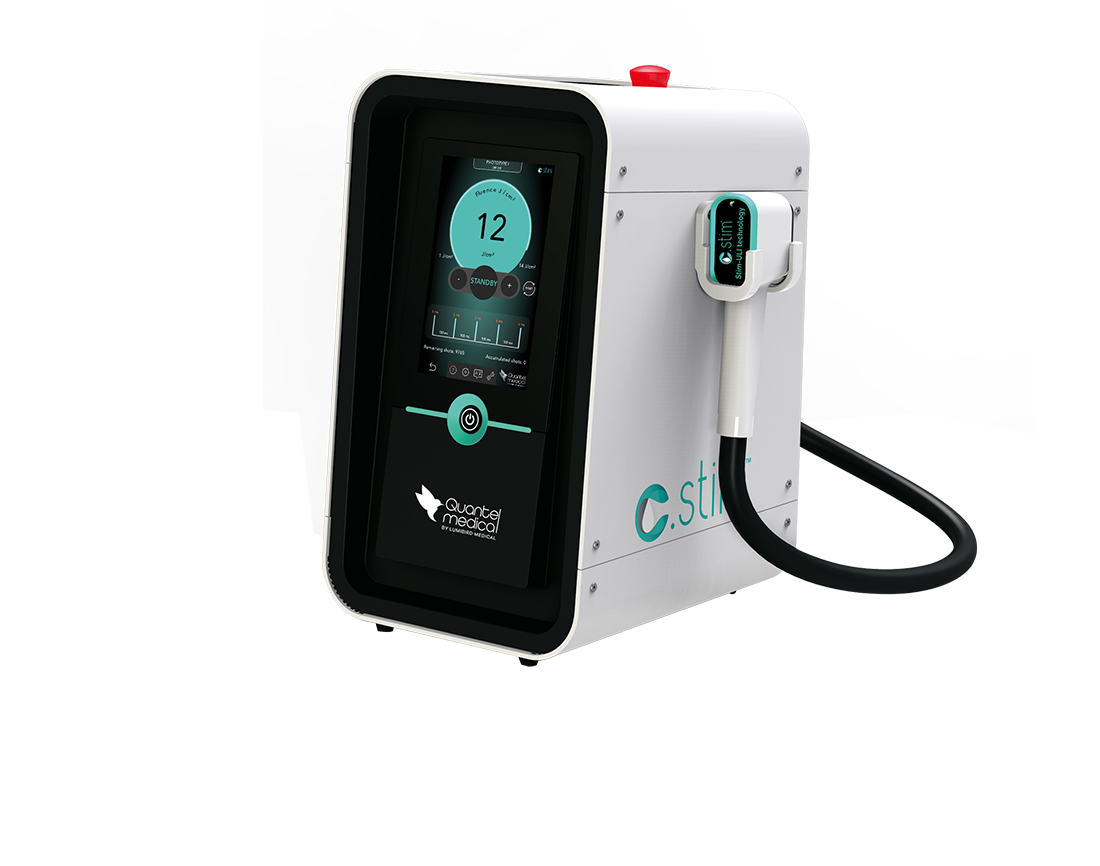
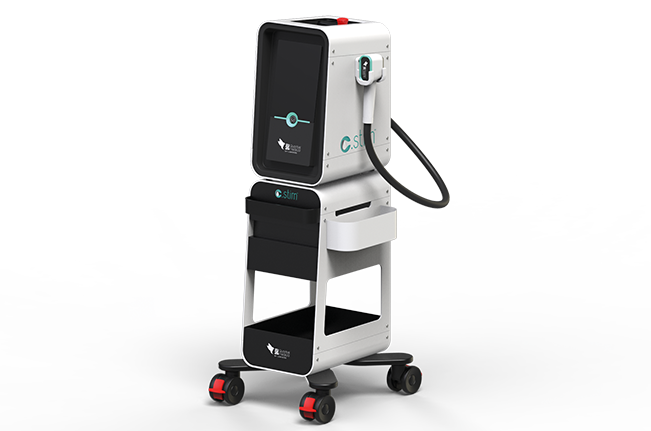
C.STIM® et Stim-ULI™ sont des marques déposées de Quantel Medical, membre de la division Lumibird Medical.
Tous droits réservés.
Mentions légales :
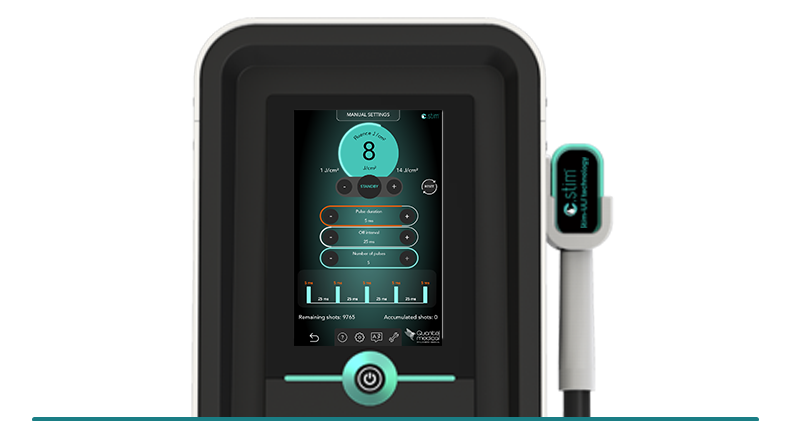
L’I.P.L. C.Stim™ est un dispositif médical de classe IIb, conçu par QUANTEL MEDICAL, et dont l’évaluation de conformité a été réalisée par l’organisme LNE / G-MED « CE 0459 ». Il est destiné aux professionnels de santé dans le cadre du traitement de la sécheresse oculaire. Pour le bon usage de ce produit, il est recommandé de suivre les indications et contre-indications détaillées dans la notice d’utilisation du produit. Document publicitaire à destination des professionnels de santé.
Date de réalisation : Septembre 2023.
Bibliographie :
1. Parasympathetic Innervation of the Meibomian Glands in Rats – Mark S. LeDoux et al. – Investigative Ophthalmology & Visual Science, October 2001, Vol. 42, No. 11.
2. Characterization of the innervation of the meibomian glands in humans, rats and mice – Bründl, M. et al. Annals of Anatomy (2021), Vol. 233.
3. Neurotransmitter Influence on Human Meibomian Gland Epithelial Cells – Wendy R. Kam and David A. Sullivan – Investigative Ophthalmology & Visual Science, November 2011, Vol. 52, No. 12.
4. The Dopaminergic Neuronal System Regulates the Inflammatory Status of Mouse Lacrimal Glands in Dry Eye Disease – Ji, Yong Woo et al. Investigative Ophthalmology & Visual Science (2021), Vol. 62.
5. TFOS DEWS II Pathophysiology Report – Anthony J. Bron, et al. – The Ocular Surface, 2017, p 441 to 515.
6. The neurobiology of the meibomian glands – Cox SM, Nichols JJ – Ocular Surface, July 2014.
7. Multicenter Study of Intense Pulsed Light Therapy for Patients with Refractory Meibomian Gland Dysfunction – Reiko Arita, et al. – Cornea Volume 37, Number 12, December 2018.
8. Rosacea: Molecular Mechanisms and Management of a Chronic Cutaneous Inflammatory Condition – Yu Ri Woo, et al. International Journal of Molecular Sciences, September 2016.
9. Rosacea: Epidemiology, pathogenesis, and treatment – Barbara M. Rainer et al. – DERMATO-ENDOCRINOLOGY 2018, VOL. 9, NO. 1, e1361574 (10 pages).
10. Treatment of ocular rosacea – Edward Wladis et al. – Survey of Ophthalmology (2018), Vol. 63.
11. Improved telangiectasia and reduced recurrence rate of rosacea after treatment with 540 nm-wavelength intense pulsed light: A prospective randomized controlled trial with a 2-year follow-up – Luo, Y. et al. – Experimental and Therapeutic Medicine (2020), Vol. 19.
12. Therapeutic Effect of Intense Pulsed Light on Ocular Demodicosis – Zhang, X., et al. – Current Eye Research 2019, Vol. 3.
13. Intense Pulsed Light Therapy for Patients with Meibomian Gland Dysfunction and Ocular Demodex Infestation – Cheng et al. – Current Medical Sciences (2019), Vol. 39.
14. Long-term effects of intense pulsed light treatment on the ocular surface in patients with rosacea-associated meibomian gland dysfunction – Seo Kyoung Yul et al. – Contact Lens and Anterior Eye (2018), Vol. 41.
15. TFOS DEWS III Management and Therapy Report - Lyndon Jones et al. – American Journal of Ophthalmology, May 2025.
16. Intense Pulsed Light for the Treatment of Dry Eye Owing to Meibomian Gland Dysfunction – Vigo, L. et al. – Journal of Visualized Experiment (2019), N°146.
17. Meibum Expressibility Improvement as a Therapeutic Target of Intense Pulsed Light Treatment in Meibomian Gland Dysfunction and Its Association with Tear Inflammatory Cytokines – Choi, M. et al. – Scientific Reports (2019), Vol. 9.
18. TFOS DEWS II Pain and Sensation Report – Belmonte Carlos, et al. – The Ocular Surface (2017), Vol. 15.
19. Analysis of Cytokine Levels in Tears and Clinical Correlations After Intense Pulsed Light Treating Meibomian Gland Dysfunction – LIU, R et al. – American Journal of Ophthalmology (2017).
20. Effect of inflammation on lacrimal gland function – Driss Zoukhri – Experimental Eye Research, May 2006; 82(5): 885–898.
21. Aqueous deficiency is a contributor to evaporation-related dry eye disease – Charles W. McMonnies – Eye and Vision (2020) 7:6.
22. Efficacy and safety of intense pulsed light of upper and lower eyelids in Meibomian gland dysfunction: A prospective multicentric study - Benítez-del-Castillo JM et al., Eur J Ophthalmol. 2023.
23. Intense pulsed light treatment for dry eye disease due to meibomian gland dysfunction; safety and efficacy in a randomized controlled study. Toyos R, McGill W, Briscoe D. - Photobiomodul Photomed Laser Surg. 2018;36(5):241-250.
24. Intense pulsed light treatment of the upper and lower eyelids in patients with moderate-to-severe meibomian gland dysfunction. Arita R, Fukuoka S, Morishige N. J Clin Med. 2022;11(12):3581.
25. Efficacy and safety of intense pulsed light delivered by the C.STIM® for treatment of Meibomian gland dysfunction - R. Auger, M.C. Trone, E. Chhuy, S. Poinard, G. Thuret, P. Gain – Journal Français d’Ophtalmologie, May 2024, Vol. 47, Issue 5.
26. Effects of Intense Pulsed Light on Presumed Neuropathic Pain Associated with Meibomian Gland Dysfunction: A Before-After Study – G. Hoarau, A.L. Best, S. Zina-Meziou , M. Benali-Abdallah, M. Loukil, Magalie Bouvet , E. Barreau, A. Rousseau, M. Labetoulle - Journal of Ocular Pharmacology and Therapeutics, January 2025, Vol. 41, No. 1.
27. Therapeutic Efficacy and Safety of Intense Pulsed Light for Refractive Multiple Recurrent Chalazia – R. Arita and S. Fukuoka - J. Clin. Med. 2022, 11(18), 5338.
28. Novel treatment of chalazion using light‑guided‑tip intense pulsed light – Y. Zhu, H. Zhao, X. Huang, L. Lin, Y. Huo, Z. Qin, J. Lu & X. Jin - Scientific Reports (2023) 13:12393.